Entries tagged with Politics.

Deflating the Balloon

Subtitle: : My unproductive fight against numbness and depression, healthcare, meditation, and what I’m doing now.

President Obama’s speech tonight provided me the opportunity to write something I’ve been wanting to share for a bit. His guiding principle, that the cycle of increased-costs-to-decreased-value that the insurance companies have been subjecting the American people to needs to end. Insurance companies, like any other for-profit enterprise, are entitled to work toward as big of a profit as they can legitimately create for themselves, but not at the cost of the health of the entities they claim to be a resource for.

Beyond proposing putting restrictions on some of the processes insurance companies are able to use, the President suggested an alternative opportunity for insurance companies to make themselves available to patients: open the world of options to a wider audience than currently exists (e.g.currently uninsured people) and let customers make the choice where to invest their attention and dollars. By redefining the parameters to create a bigger world to play in, the overinflated balloon of suffering caused by the limitations of the day-to-day process can be deflated and replaced with a more workable and productive model, that ideally will find an equilibrium between stress points and air flow.

What does all of this have to do with me (and maybe you too)? Read on!

As some of you may or may not know, I’ve struggled on and off with chronic depression for most of my adult life. I have lived my last 15 years in a state of aversion, using any number of distractions (food, the internet, unhealthy relationships) in order to try to get out of my head, or not have my thoughts rule me.

I’ve never known what people meant when they said ’stop thinking so much’. What other option is there? How does one interact with the world if not through one’s brain? I’ve been working in therapy for awhile now, trying to think my way out of this situation, which I’d defined as a sense of ‘coasting without connecting’, leading up to ‘not feeling like part of the world’. I thought I could figure out some way to stay in my head (which is the only place to be) but just nice-and-easy integrate my emotions back into my life.

All this came to a head last week when, in a “be careful what you wish for” epic fail moment, all the distractions I’d relied upon to not have to deal with myself suddenly stopped being effective in keeping me out of my brain, and I spiraled into a debilitating depression.

I stayed off of the internet, TV held no interest, I stopped eating altogether. I was desperately in search of an answer, something, ANYTHING that could be done to help me to figure out how to understand and escape my all-too-familiar situation. I didn’t know where the release valve on my suffering was, but I was at the end of my rope and willing to search anywhere for an escape hatch. Somehow in the midst of all this, the concept of meditation entered my brain.

I’ve been trying to learn how to meditate off and on for years, but I never really “got it”. It always seemed rather silly to me, how somehow sitting quietly could possibly solve my very real problems, challenges and self-imposed restrictions keeping me from being happy. It didn’t seem like DOING anything, and therefore it held no weight beyond a novelty. But now, in the desperate quest to find answers outside myself, I asked my Twitter folks for meditation resources, and was directed Radical Aceptance: Embracing Your Life with the Heart of a Buddha, which ended up being a life-altering discovery.

The book, written by Tara Brach, opened my eyes to the totally understandable habitual and very common folly of paying attention to the reptillian brain’s thought processes. Within these pages it is explained in plain language that the thoughts that I’d gotten completely caught up in are the automatic responses of our evolutionary fight-or-flight process. They are comprised entirely of judgments “this is good” “this is bad” “this is dangerous”. They are not rational, nor are they ‘intended’ to be. They are just the brain’s way of processing experience. The trouble happens when we begin to take these automatic responses at face value, when we begin to believe them.

I believed them. I got caught in them. I bought into the fundamental rational conclusion that one comes to when identifying with these thoughts: I’m not good enough. Something is wrong with me. I can never experience love or peace. I don’t deserve these things. And once I got caught in it, there was seemingly no escape.

It turns out, however, that you can’t think your way out of being caught up in thought. It seems simple when phrased like that, but as any of you who have been caught in depression know, when you’re in it there is no past where you felt better, there is no potential future where you can feel better, and it seems like the only way to get out is by some external source (said much better than I have here by Robert Burton in his The Anatomy of Melancholy, published in 1621.) The rallying cry of the depressed is “Save Me” for a reason.

I decided, as a last resort (before looking into a pharmacological option) to commit myself to investing in meditation. This resulted in probably the most intense weekend (three day weekend, no less) of my life thusfar.

In my newfound “I’m going to give this a serious chance”, I discovered that Tara Brach has a free podcast where she expands upon her teachings from the Radical Acceptance book and leads her class in guided meditations (which are basically real-time audio or visual instruction guiding you through the process of becoming aware of your awareness and focusing on your core being rather than getting caught up in thoughts or emotions that are connected to automatic processes). Our consciousness is ‘prior’ to these processes. It’s closer to us.

I listened and learned and focused and tried it. And something finally clicked. This is the other option.

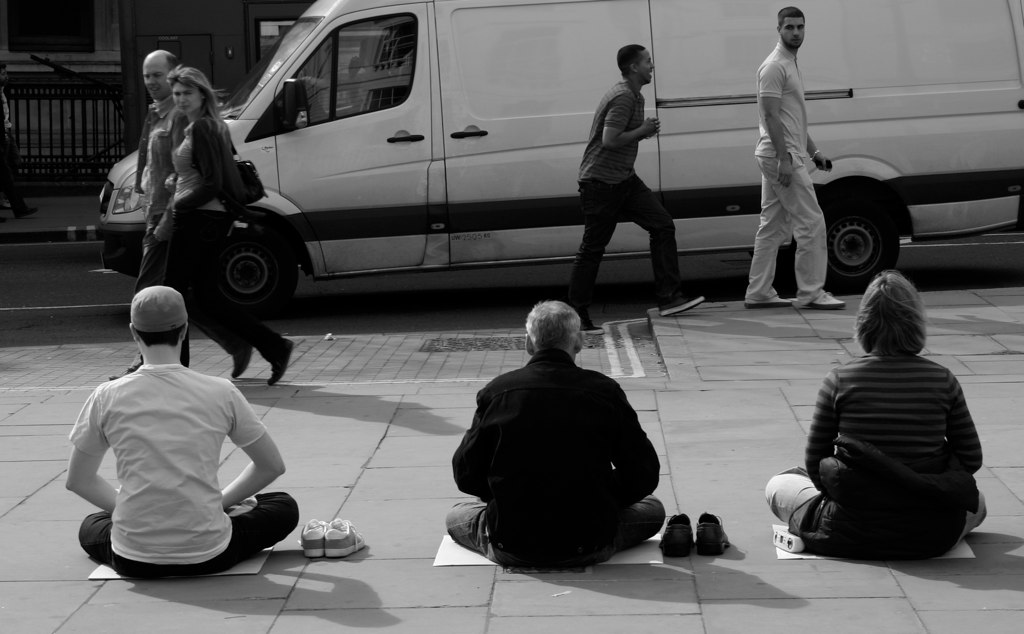
Finding myself sitting by the East River, eyes closed, listening to the sound of Tara’s soothing voice for hours at a time, I began to learn how to connect with my awareness, that which is more centrally ‘me’ than the thoughts, the emotions, the dread. Through these three days of intense change, I’ve gotten closer to becoming in sync with my core being than I’ve ever been, and learned that the way out is actually within us. I finally felt like I’d identified where the release valve was.

It was not easy. It did not come quickly. I’m lucky enough to have a Mom who went through something similar, and found similar release in the practice, and was able to offer invaluable information, advice and support.

Since then, I’ve been meditating for 20 minutes every morning. I’m beginning to feel the effects. I am able to get out of my head more quickly than before. I pay more attention to the world around me. I smile at people on the street, and get smiles back. I’m learning to ask questions when I’m unclear about something, rather than making assumptions that add to my stress level of a particular task at hand. Obviously I’m very new to this process and am still getting the hang of it.

What’s the point? Beyond my full and unreserved support for this practice (especially for my fellow geek friends who have similar challenges getting out of their own way), the point is, I’m learning to deflate the balloon. My balloon had expanded to the breaking point. It hit the wall. The only way out was to let go, let the balloon deflate, let it go slack, find another way to get the goal of living done. Change doesn’t come when we’re comfortable, it’s only in a crisis that change is possible. I’m tempted to make a comparison to business and social media trends here, but you’re all smart enough to get there yourselves, yes?

I haven’t been on Twitter (or blogging) quite as much, I’m a little different in how I interact with the world now, I’m learning to spend more time in the cool glow of presence and connection to the world. I’m figuring out what really matters to me (turns out, as with most people, it’s ‘connection’). I’m working on me. I’m figuring out how to work with my balloon to find equilibrium. I am.

Am I going to give up all my worldly possessions and go live on a monastery somewhere? Probably not. I’ve never been particularly religious, though I’ve always believed that you get what you give (i.e. Karma). The meditation practice does not require any particular religious belief, only a belief in our own primal nature, before thought, before emotion, and a commitment to loving kindness to all beings. There are plenty of resources on the web that can describe all this stuff in far greater detail, and I encourage exploration.

I hope this post will inspire any reader who finds themselves in a similar situation to consider this path as an option, and hope to continue being mindful as much as I can for as long as I can.

Thank you for listening, hearing and loving.

P.S. I realize that I addressed a bunch of this stuff in my “You Matter” post. I was considering revising it to take into account this new perspective, but I think its more interesting to be left alone as a ‘before and after’ study.

Bill Hicks: The Master

Bill Hicks
Image via Wikipedia

Bill Hicks was (and is still) one of the sharpest minds in comedy of all time.  From religion to politics to drugs to sex, his acid tongue deconstructed the hypocrisy and conveyed a sharp anger about life that was just as thought-provoking as it was hilarious.

Here’s Bill at the peak of his powers on “One Night Stand”

[via The Naked Gord Program]

Reblog this post [with Zemanta]

How did we get here: The fundamental similarities in failing industries and the transition economy

The Airline Industry.  The Music Business.  The Financial Markets.  The US Auto Industry.  What do each of these areas have in common and what can they teach us about the current state of our economy?

First off, I’d like to posit that we are not only in a recession, but what we’re seeing is the result of the inability and unwillingness of major swaths of the corporate infrastructure to address the shift from relatively uneducated consumers who have respond mostly to advertising, celebrity endorsements, and lack of opportunities to get information.

With the exponential growth of information online and how easy its become for people to share their experiences, opinions (both good and bad) and recommendations with friends and an almost unlimited number of strangers (see Yelp, Twitter, Blogs in general), these businesses stumble and fall.

Each industry is based on business practices that:

  • Show apathy or even contempt for their customer base (here’s what we make, buy it..where else are you gonna go)
  • Have relied on a historical lack of alternate options (pre-Napster, lack of competitive foreign cars until recently)
  • Are resistant to internal change and innovation (electric cars, hybrids, DRM, etc)

Unfortunately, this kind of business strategy (what they don’t know won’t hurt us) has been the backbone of some of the most central industries in our country, and the failure of the process is taking a devastating toll.

All is not doom and gloom, however.  There has never been a better opportunity for industry to shift our strategy from a business-centric customer-be-damned model to a customer-focused, service-oriented one.  The few exceptions in each of the aforementioned areas (JetBlue, for example) are not suffering as much because they’ve positioned themselves and behave as a customer service company that also happens to be an airline.

This is all well and good coming from me, seeing as I am employed and know how I’m going to pay my next rent check, but another thing I find fascinating and optimistic about our current crisis is that it also overlaps with another pressing issue, the environment.

We have millions of skilled laborers, engineers, mechanics, accounting people, number crunchers out of jobs right now.  Where is there a shortage of exactly those kind of people?  INFRASTRUCTURE.  It seems to me that with the right training, people who worked 20 years building carborators could very easily be building solar panels, or wind turbines, or bridges or working on the electrical grid.  And so on and so on.

Hence, my overall conclusion that this is not just a recession, but a transformative period in American industry.

I only hope the systems can be put in place to make available these Green jobs to people who sorely need them.

Obviously, these examples are an oversimplification of a highly complex issue, but I’m very excited to see what the immediate future holds for where American workers are headed.

[Inspired by Jeff Jarvis: A fundamental restructuring is underway]
[for more: Bruce Nussbaum: The Transformation Conversation: Is "Transformation" a Better Concept Than "Innovation" to Guide us Forward?]

Reblog this post [with Zemanta]

The Third Debate: A Story in Snarky Facebook Updates

Anyone who’s my friend on Facebook is by now well aware that during each debate I kept a running commentary of my own snark about what people are saying.

For those of you who arent my FB friend, I present for your amusement, my commentary from the third Presidential debate, in chronological order for your pleasure.

Jeremy wonders what number McCain thinks would be okay for Obama’s tax plan to consider “middle class”…. $500k? $750k? 9:14pm

Jeremy during the depression era, “we”… oooh not a good thing to say. 9:17pm

Jeremy thinks these are the same talking points from the last debate. 9:20pm

Jeremy maybe mccain was associated with the worst chapter in american history…the civil war! 9:27pm
Jeremy is amused by Obama’s “Whatchoo talkin bout, Honky!” smile. 9:36pm
Jeremy waits for the moment when McCain realizes he’s monumentally screwed. 9:41pm
Jeremy out with the old, in with the fresh air in washington…is that really the argument you want to make, mister 26 years in congress? 9:44pm
Jeremy wants to build 45 new nucular powered pants. 9:47pm
Jeremy is sick of McCains stupid hook-around left-handed writing on his pad. 9:50pm
Jeremy is surprised McCain can IDENTIFY eloquence, mister stutt-stutt-stutter. 9:53pm -
Jeremy is getting hammered, just like the auto makers. 9:54pm
Jeremy can’t believe mccain is citing Colombia as a good partner…how much money spent funding both sides of the drug war? 9:56pm
Jeremy wait…did he just call me fat? 9:59pm
Jeremy wonders if Joe the Plumber is the same as Joe Sixpack. 10:03pm
Jeremy notes that one can be anti ‘roe v wade’ and also not necessarily pro-life. 10:09pm – (note: this one got me a lot of confused IMs.  I’m not pro-life, I just think that theres an argument that isn’t pro-life as much as ‘let the states decide’
Jeremy thinks theres gotta be someone who’s pro-abortion. 10:15pm -
Jeremy thinks Obama is now just ripping stuff out of West Wing Season 2 scripts. 10:18pm
Jeremy went to a charter school. What do they have to say about Regents exams? 10:20pm
Jeremy thinks that every school with more than 300 people needs to be split up. 10:21pm
Jeremy did he just say that he belived that children are our future? 10:23pm
Jeremy McCain/Rain Man ‘08. 10:25pm -
Jeremy loved Bob Schieffer when he played Mark Twain on broadway. /obscure? 10:37pm
..fin *bow*

Some thoughts on the debate, not that you asked.

  • Sad but not surprising that there was no mention of Darfur
  • Why does ‘a debate on foreign policy’ exclusively mean war and talking about countries that hate us
  • I found it interesting that McCain referred to Obama ‘Senator Obama’ and Obama called McCain ‘John’
  • Neither side had a slam dunk
  • Some of the Obama Magic is wearing off the more he talks about policies and things in Washington-ese
  • I’m not sure it was the best idea to allow direct interaction between the candidates, although I’m not happy about not thinking its the best idea
  • Somewhere in an attic, there is an portrait of George Stephanopolis that’s aging.
  • The snarky Facebook status messages were flying a mile a minute.  I’m sure Twitter was the same way.

Your thoughts?